

Soil nailing is a ground stabilisation technique in which steel bars are inserted into drilled, grouted holes in a slope or excavation face to reinforce the soil in place. Shotcrete is concrete sprayed at high velocity onto that face to hold the soil between the nails and protect it from erosion. The two are used together to stabilise cut slopes, retaining faces, and deep excavations. In Kerala, where steep terrain, laterite soils, and heavy monsoon rainfall create significant slope stability challenges, these techniques are widely applied in both infrastructure and building projects.
Kerala’s terrain changes quickly. Within a short distance, you can move from coastal plain to midland laterite to the steep slopes of the Western Ghats. Add among the heaviest rainfall in India, and the result is a state where slope stability is not an abstract engineering concern but a practical, recurring one.
For anyone building on a hillside plot, cutting into a slope to create a building platform, excavating a basement in a confined site, or dealing with a retaining structure that has started to move, conventional retaining walls are not always the right answer. Soil nailing and shotcrete often are.
This guide explains both techniques, when each is appropriate, how the work is carried out, and what to look for in a contractor.
What Is Soil Nailing?
Soil nailing reinforces existing ground rather than replacing it. Steel bars, called nails, are installed into drilled holes across the face of a slope or excavation and grouted in place. The nails bond with the surrounding soil, and the reinforced mass behaves as a single stable block rather than a face that can slide.
Crucially, the work proceeds top-down, in stages. A section is excavated, the nails for that level are installed, and the face is treated, and only then does excavation move to the next level. This sequence is what allows soil nailing to be used where the ground must remain stable throughout construction.
Key characteristics
- Reinforces soil in place rather than importing new material
- Installed in stages from the top down
- Requires no large working space behind the face
- Can be temporary (construction support) or permanent (retaining structure)
- Generally faster and more economical than a conventional retaining wall of equivalent height
What Is Shotcrete?
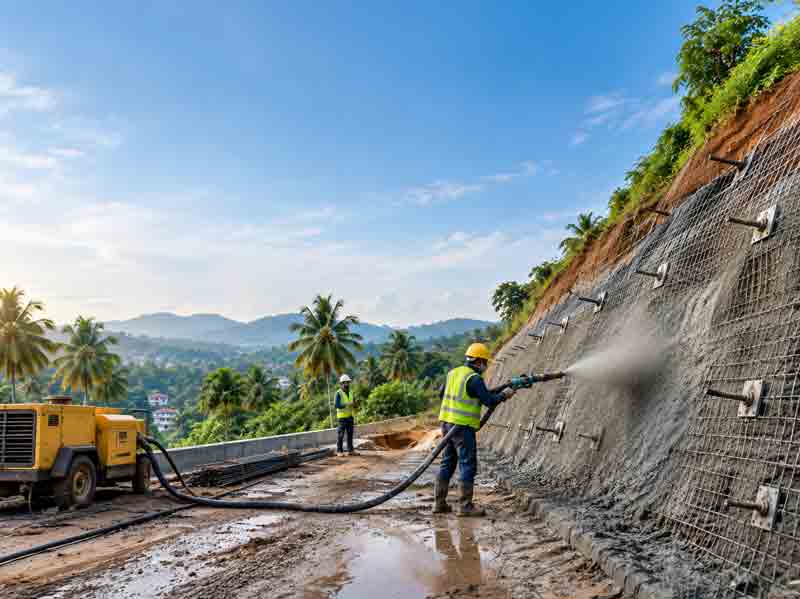
Shotcrete is concrete conveyed through a hose and sprayed at high velocity onto a surface. The force of application compacts the material as it lands, producing a dense layer that bonds directly to the face.
On a soil-nailed slope, shotcrete performs three jobs: it holds the soil between the nails, it protects the exposed face from rain and erosion, and it ties the nail heads together into a continuous structural facing, usually with steel mesh or fibre reinforcement.
Shotcrete is also used independently for structural strengthening, repairing deteriorated concrete, lining channels and tanks, and tunnel support.
Why it suits slope work
- Conforms to irregular and curved faces where formwork is impractical
- Applied without shuttering, which speeds up staged construction
- Bonds directly to the prepared surface
- Can be finished rough for temporary work or smoothed and sculpted for permanent walls
Why Kerala Needs These Techniques
Steep terrain. Hillside plots in the highlands and midlands frequently require cutting into slopes to create level building platforms. Every cut face needs support.
Laterite soil. Kerala’s characteristic laterite varies considerably in strength, from hard and competent to weathered and friable, sometimes within a single site. Faces that look stable when dry can behave very differently when saturated.
Heavy monsoon rainfall. Water is the primary driver of slope failure. Saturation increases weight, reduces shear strength, and raises pore water pressure within the slope. Kerala receives this loading twice a year.
Landslide-prone zones. Parts of the Western Ghats region experience slope failures during intense rainfall. Engineered stabilisation is a recognised response where development occurs in these areas.
Confined urban sites. In town centres, basement excavation often happens close to existing buildings and boundary walls. Soil nailing requires no space behind the face, unlike conventional retaining structures.
Where Soil Nailing and Shotcrete Are Used
- Cut slopes for hillside residential and commercial plots
- Permanent retaining faces in place of conventional walls
- Temporary excavation support for basements and deep foundations
- Stabilisation of slopes showing signs of movement
- Road and highway cut sections
- Repair and strengthening of existing retaining structures
- Protection of exposed faces against erosion
How the Work Is Carried Out
Step 1 - Site and geotechnical assessment. Soil profile, strength parameters, groundwater conditions, slope geometry, and surrounding structures are evaluated. This governs everything that follows.
Step 2 - Design. A qualified geotechnical or structural engineer determines nail length, diameter, spacing, inclination, grout specification, shotcrete thickness, and reinforcement, along with the staged excavation sequence.
Step 3 - Staged excavation. The first lift is excavated to the designed depth, typically one to two metres, exposing a face that must remain stable until it is treated.
Step 4 - Drilling. Holes are drilled into the face at the specified angle, spacing, and depth.
Step 5 - Nail installation and grouting. Steel bars are inserted, and the holes are grouted so the nails bond with the surrounding soil.
Step 6 - Mesh and shotcrete. Reinforcing mesh is fixed across the face, and shotcrete is sprayed to the specified thickness. Nail head plates are fitted to connect the nails to the facing.
Step 7 - Drainage. Weep holes and drainage provisions are installed to relieve water pressure behind the face. In Kerala, this step is not optional - it is often what determines whether the structure performs through successive monsoons.
Step 8 - Repeat and verify. The sequence repeats for each subsequent lift. Pull-out testing on sacrificial nails verifies that the design assumptions hold in the actual ground.
Soil Nailing Compared to Other Retaining Options
|
Method |
Working space needed |
Suits irregular faces |
Typical use |
|
Conventional RCC retaining wall |
Large excavation behind |
No |
Open sites, moderate heights |
|
Gravity/gabion wall |
Moderate |
Limited |
Lower heights, rural sites |
|
Soil nailing with shotcrete |
Minimal |
Yes |
Cut slopes, confined sites, staged excavation |
|
Sheet piling |
Moderate |
No |
Soft ground, high water table |
Each has its place. Soil nailing is particularly advantageous where space is restricted, the face is irregular, or excavation must proceed in controlled stages.
Important Limitations
Soil nailing is not universally applicable, and any contractor who says otherwise should be treated with caution. It is generally unsuitable for:
- Cohesionless soils that cannot hold an open face long enough for treatment
- Organic or highly compressible soils
- Excavations below the water table without dewatering
- Ground where drilling cannot be reliably maintained
This is precisely why a geotechnical investigation must precede any decision. The method is selected to suit the ground, never the other way round.
Choosing a Soil Nailing and Shotcrete Contractor in Kerala
This is specialist work with real consequences if executed poorly. Look for:
- Geotechnical and structural engineering input on the design, not just execution
- A soil investigation forming the basis of the design
- Appropriate equipment - drilling rigs, grout pumps, shotcrete machines, compressors
- Documented experience with Kerala’s laterite and slope conditions
- Proper drainage design integrated into the works
- Verification testing of installed nails
- Staged methodology with a clear excavation sequence, rather than open-cut followed by remedial support
- Ability to continue into the main construction, avoiding gaps between contractors
Ask how the contractor handles water. In Kerala, drainage is the difference between a face that lasts and one that fails in its third monsoon.
Soil Nailing and Shotcrete with Idea Builders
Idea Builders & Developers Pvt. Ltd. has worked across Thrissur and Kerala since 1999, with over 26 years of experience in residential, commercial, and specialist structural construction.
Specialist ground and structural services include:
- Soil nailing for slope stabilisation and excavation support
- Shotcrete application for facing, lining, and structural strengthening
- Pile foundation for weak and waterlogged ground
- PU injection for crack sealing and water ingress
- Structural strengthening and steel structure works
- Waterproofing designed for Kerala’s rainfall
Because the same team also handles foundations and full building construction, slope stabilisation can be planned as part of the project rather than treated as a separate contract - which matters when the stabilisation work and the building it supports must be sequenced together.
Conclusion
Soil nailing and shotcrete are not exotic techniques. They are the standard engineered response to a problem Kerala presents constantly: ground that must be cut into, built against, or held in place, under rainfall that tests every assumption made about it.
The decisions that matter are made before any drilling starts - the geotechnical investigation, the design, and above all, the drainage. Get those right, and the system performs for decades. Skip them, and no amount of shotcrete will compensate.
If your project involves a cut slope, a confined excavation, or a retaining face that has begun to move, the first step is an assessment of the ground, not a quotation for the work.
???? Call: +91 9400 602068
✉️ Email: info@ideabuilders.in
???? Idea Tower, Perumbillissery, Cherpu P.O., Thrissur, Kerala – 680561
???? www.ideabuilders.in