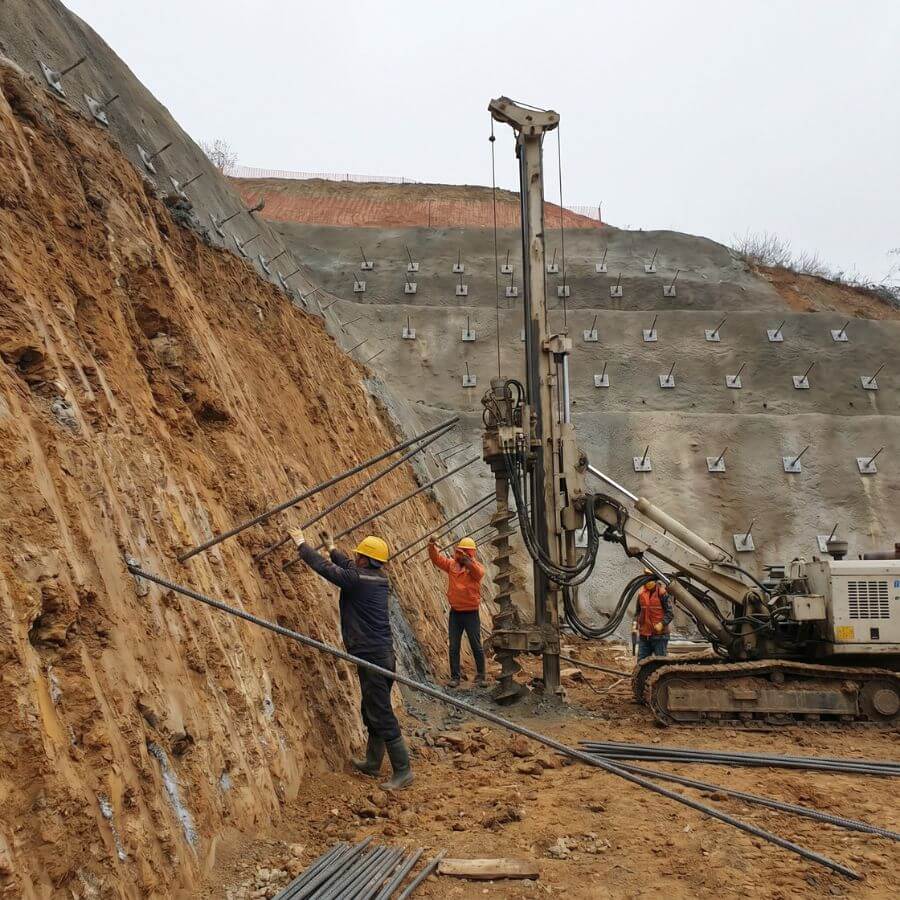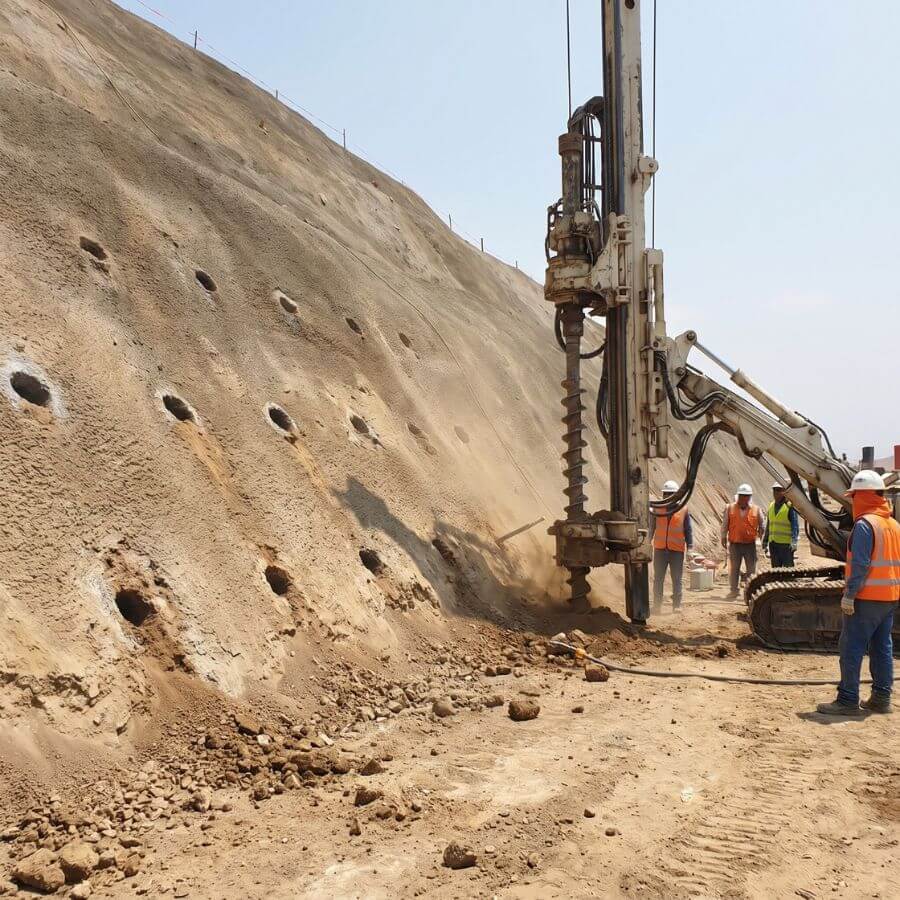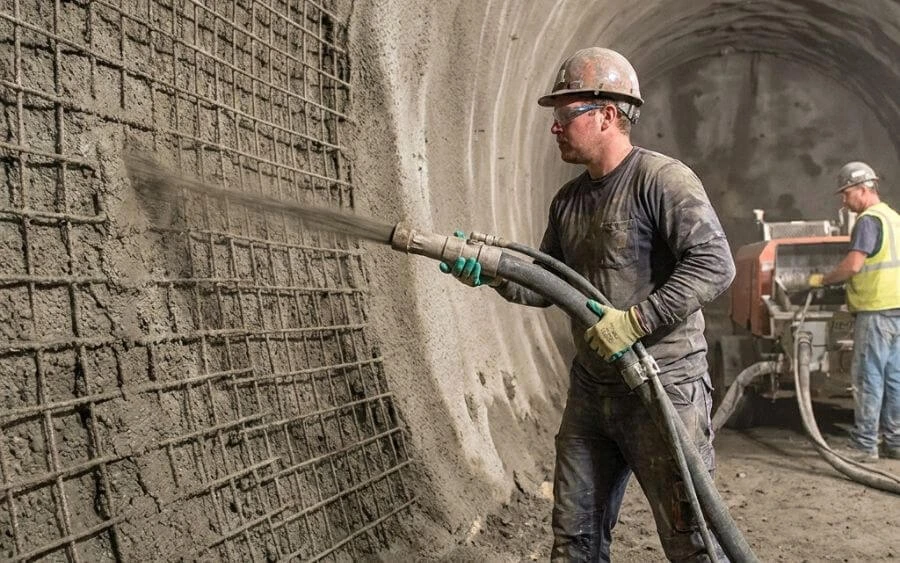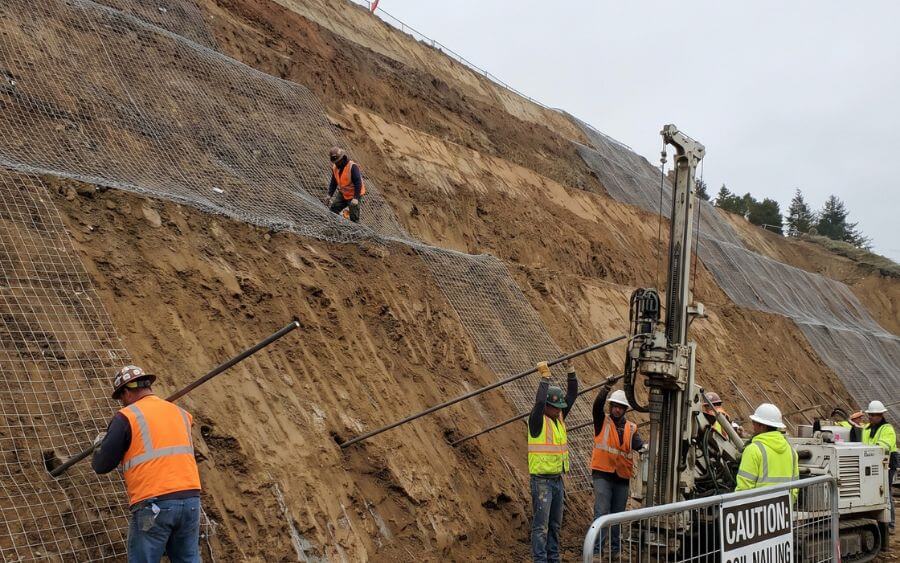
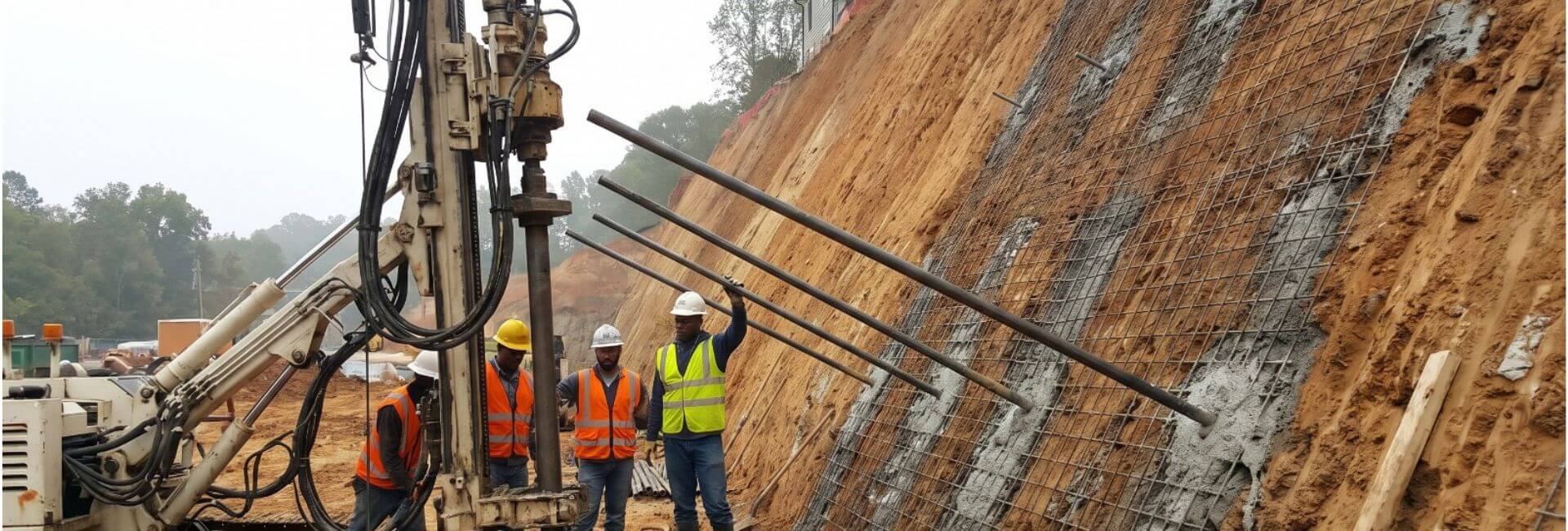
Soil nailing is a ground improvement technique used to reinforce and stabilize soil in slopes, excavations, and retaining walls. The process involves inserting slender steel bars, known as nails, into the soil at regular intervals and securing them with grout. As the grout sets, the nails bond with the surrounding earth, creating a reinforced mass that resists movement and holds its shape under load.
Unlike traditional retaining walls that are built before excavation, soil nailing is installed as the excavation progresses, working from the top down. This makes it a practical, cost effective choice for projects where space is limited or where deep excavation is required close to existing structures.
Soil nailing serves several important functions on a construction site. It increases the overall shear strength of the soil, reduces the risk of slope failure, and controls ground movement during excavation. It also allows for steeper cuts than would otherwise be safe, which can save both time and material. Beyond new construction, the technique is widely used to stabilize existing slopes, repair failing retaining walls, and support infrastructure like roads, railways, and bridge abutments.
Because it relies on the natural strength of the soil itself, working with it rather than against it, soil nailing tends to require less excavation and fewer materials than conventional retaining systems, without compromising on strength or long term stability.
If your project involves a slope, excavation, or retaining structure that needs reliable reinforcement, talk to Idea Builders about soil nailing. Get in touch today for a site assessment and a straightforward quote.
Find answers to common questions about Ideabuilders.
Soil nailing suits situations where a conventional wall is difficult, slow or expensive to build. Because it is installed from the top down as excavation proceeds, it needs no working space behind the face and no large temporary excavation, which makes it practical on constrained plots, alongside existing structures, and on sites where access for heavy equipment is limited.
A conventional gravity or RCC retaining wall remains appropriate where the ground cannot hold an unsupported cut, where the wall must be built before excavation, or where the required face is fully exposed and free-standing. On sloping and hillside plots the two are often combined, with nailing stabilising the cut and a facing or wall completing it.
Soil nailing works in ground that can stand unsupported for the short period between excavating a lift and installing the nails. Stiff to hard clays, dense or cemented sands, weathered rock and firm laterite are generally suitable, which covers a good deal of Kerala's hill and midland terrain.
It is less suitable, or needs modification, in loose saturated cohesionless sands that cannot hold a face, in very soft clays, in ground with heavy groundwater inflow, and where large boulders or highly variable fill make drilling unpredictable. This is why a soil investigation and site assessment precede any nailing design. Recommending a nail pattern before knowing the strata is guesswork with a slope attached to it.
Yes, and remedial work is one of its most common applications. Nails can be installed through an existing distressed retaining wall or into a slipping slope to tie the unstable mass back into firm ground behind the failure surface, restoring stability without demolishing and rebuilding the structure.
The essential first step is diagnosing why the failure occurred. Most slope and wall failures in Kerala are triggered by water, whether from blocked or absent drainage, saturated backfill during the monsoon, or altered surface flow after nearby construction. Nailing a slope without correcting the water regime treats the symptom, and the slope will move again.
It is frequently chosen precisely for that reason. The top-down staged sequence means only a limited height of face is exposed at any time, and drilling and grouting generate far less vibration and ground disturbance than driven systems, so it is well suited to deep excavations close to neighbouring structures.
One point owners should know early: nails extend horizontally into the ground behind the excavation face, and on a tight plot that ground may lie beneath a neighbouring property or a public road. Where it does, permission or an easement is required. This is a straightforward matter to resolve at design stage and a serious dispute if discovered after installation, so nail lengths and boundary positions are checked together during planning.
It will if drainage is designed as part of the system rather than added afterwards. Nails resist soil movement, but rainfall infiltration and rising pore water pressure behind the face are what drive most slope failures in Kerala, and a sealed facing without drainage traps that pressure instead of relieving it.
A properly detailed system includes weep holes through the facing, drainage strips or geocomposite behind it, surface drains at the crest to intercept runoff before it reaches the face, and controlled discharge away from the toe. Vegetation, surface protection and periodic clearing of drains before each monsoon all contribute to long-term performance.
Verification centres on pull-out testing. Sacrificial test nails are installed and loaded to confirm the actual bond strength achievable in that ground, and proof tests are then carried out on a proportion of production nails to confirm they perform as designed. Drilling records, grout quality and nail placement are logged through installation.
Cost and duration are governed by the height and length of face, nail length, diameter and spacing, ground conditions and drilling difficulty, the facing specified such as shotcrete with mesh, and site access. Idea Builders provides a site assessment and a straightforward quote before work is planned, on +91 9400 602068 or at info@ideabuilders.in.