

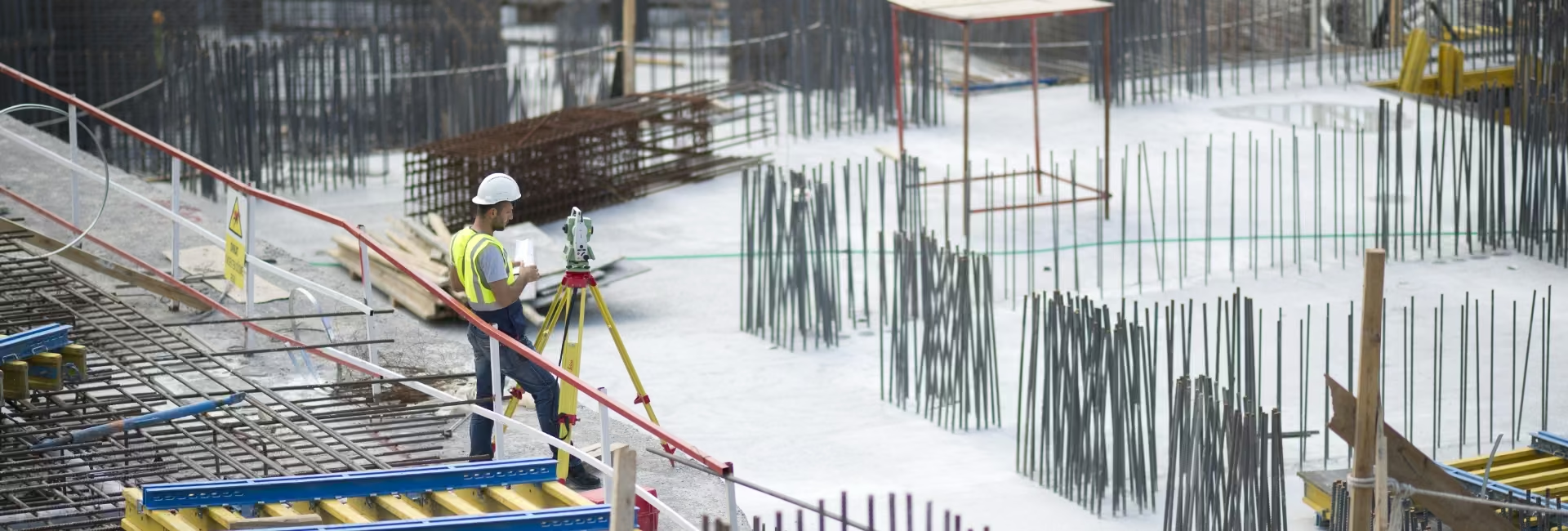
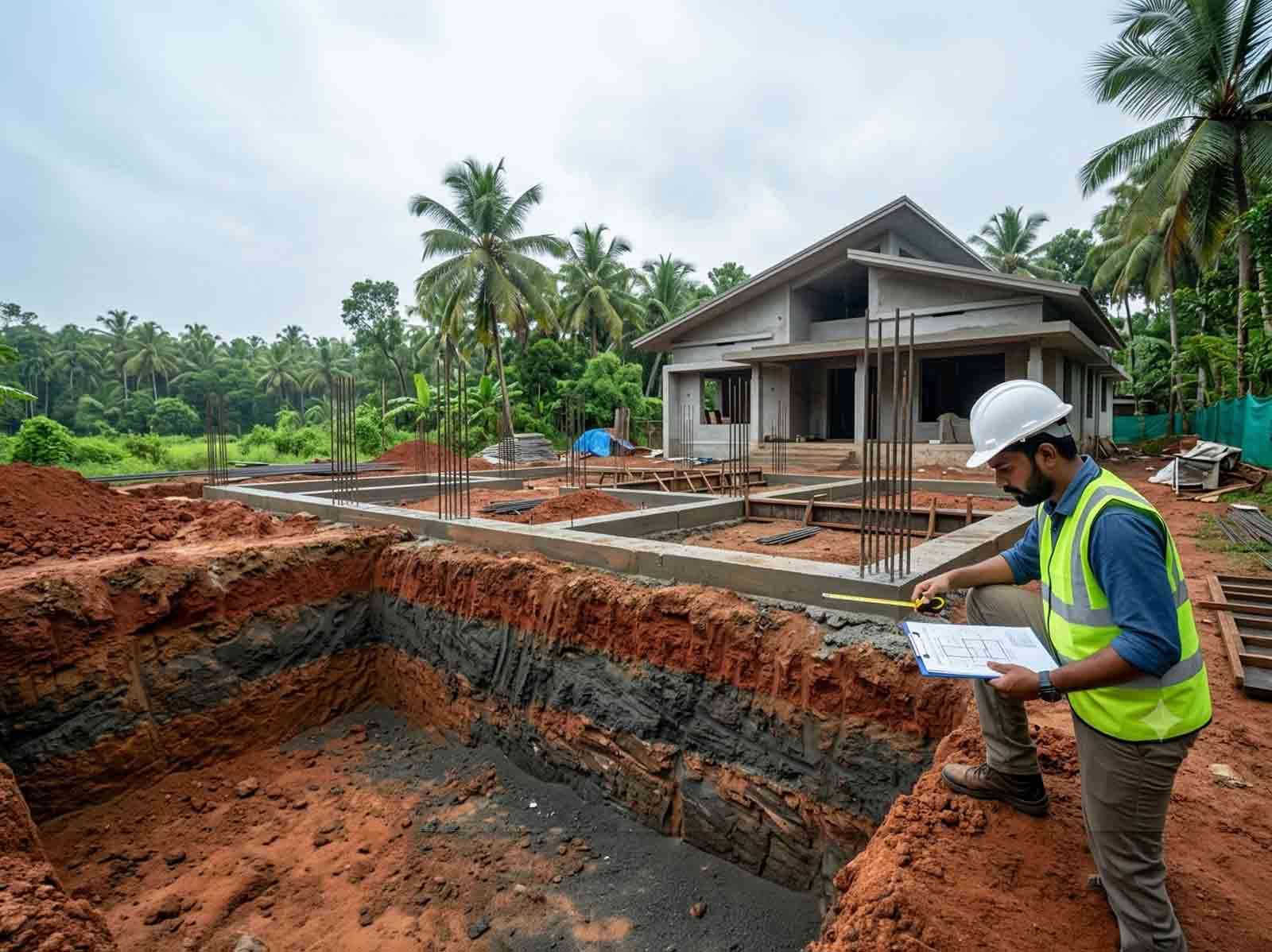
A strong building starts from the ground up. The foundation is responsible for transferring the weight of a house or building safely into the soil, so choosing the right foundation type is one of the most important decisions in any construction project.
In Kerala, foundation design cannot be based simply on what was used for a neighbouring property. Soil conditions can change significantly between coastal areas, lowlands, midlands, slopes, and highland regions. Kerala has coastal alluvium, mixed alluvium, laterite, red soil, black cotton soil, hill soil, and other soil conditions. Some areas also experience high groundwater levels or seasonal flooding.
So, how do you choose the right foundation based on soil conditions in Kerala? The answer depends on soil strength, depth of competent soil, groundwater, building loads, settlement risk, slope, and the findings of a proper site investigation.
Why Soil Conditions Matter for Foundation Design
The same foundation may not perform equally well on every site.
A foundation must safely support the building while controlling excessive settlement, tilting, and structural movement. Before selecting a foundation, engineers need to understand the characteristics of the soil beneath the proposed building.
Important factors include:
- Soil type and composition
- Safe bearing capacity
- Soil density and strength
- Depth of suitable founding strata
- Groundwater level
- Soil settlement characteristics
- Site slope
- Existing fill or reclaimed soil
- Building size and number of floors
- Structural loads
- Drainage and flood conditions
Indian Standards recognize subsurface investigation as an important part of foundation planning. BIS lists IS 1892:2021, Subsurface Investigation for Foundations, as the relevant code of practice, while BIS guidance also explains that soil investigation helps determine a suitable foundation type and provides the basis for safe foundation design.
Common Soil Conditions in Kerala
Kerala has diverse geological and soil conditions. Understanding the general characteristics of the site is the first step toward selecting an appropriate foundation.
1. Laterite Soil
Laterite is widely found across Kerala, particularly in the midland region. Kerala Soil Survey describes laterite soils as occurring mainly between the coastal belt and hilly mid-upland areas.
Laterite sites can sometimes provide suitable founding conditions, but the actual strength and depth of the lateritic layer must be verified.
A site may have:
- Hard laterite
- Weathered laterite
- Soft or fractured layers
- Variable soil depth
- Laterite over weaker material
Therefore, the colour or apparent hardness of soil should not be used alone to decide the foundation type.
Depending on the investigation results and structural loads, conventional shallow foundations may be considered where adequate bearing strata are available.
2. Coastal and Sandy Soil
Coastal areas can contain sandy soils and may have relatively high groundwater levels. Kerala Soil Survey notes that coastal alluvium occurs along the coastal plains and that groundwater can be high in these areas.
For such sites, engineers need to consider:
- Soil density
- Groundwater level
- Bearing capacity
- Settlement
- Excavation stability
- Drainage
- Scour or erosion where relevant
A shallow foundation may be appropriate in some conditions, while deeper or specially designed foundations may be required where the near-surface soil cannot safely support the proposed structure.
3. Alluvial and Soft Soil
Alluvial soils are common around river systems, lowlands, and certain flood-prone areas. In parts of Kerala, mixed alluvium can have clayey or sandy textures and may experience flooding, stagnation, and high groundwater levels during the rainy season.
Soft or compressible layers can create settlement concerns.
In these situations, the design may require:
- Wider or deeper shallow foundations
- Ground improvement
- Raft foundations
- Deeper foundations
- Pile foundations
The correct solution depends on the soil investigation and structural requirements rather than soil type alone.
4. Black Cotton Soil
Black cotton soil occurs in parts of Palakkad district. Kerala Soil Survey describes these soils as having high shrink-swell capacity and characteristic cracking during dry periods.
This type of soil requires special attention because volume changes can affect foundation performance.
Engineers may need to consider:
- Seasonal moisture variation
- Swelling and shrinkage
- Depth of active soil
- Settlement
- Foundation depth
- Ground improvement or specialized foundation systems
A proper geotechnical assessment is especially important before construction on expansive soil.
5. Filled or Reclaimed Land
A plot may appear suitable for construction but contain artificially filled soil.
Uncontrolled fill can settle when subjected to building loads, particularly if it has not been properly compacted.
Before construction, engineers should determine:
- What material was used for filling
- Fill depth
- Degree of compaction
- Soil strength
- Presence of organic material
- Depth of natural competent soil
If the fill is unsuitable, the foundation solution may involve removing and replacing soil, improving the ground, or transferring the structural load to deeper competent strata.
How Soil Testing Helps Choose the Foundation
A soil test is not simply a formality. It provides information required for foundation design.
A proper investigation can help determine:
1. Soil Bearing Capacity
Bearing capacity indicates how much load the soil can safely support under the proposed foundation conditions.
2. Soil Profile
Testing helps identify different soil layers and their depths.
For example:
Topsoil → Soft clay → Dense soil → Weathered rock
This information can influence the required foundation depth and type.
3. Groundwater Level
Groundwater can affect excavation, foundation construction, soil behaviour, and long-term durability.
4. Settlement Characteristics
Two soils may have similar apparent strength but behave differently under long-term loading.
5. Engineering Properties
Depending on the project, soil investigations can include field and laboratory testing to understand properties relevant to the proposed structure. Kerala's soil and foundation research facilities conduct soil exploration and laboratory testing for engineering assessment.
Which Foundation Is Suitable for Different Soil Conditions?
There is no single foundation type that is automatically correct for a particular soil category. The final choice should be made by a qualified structural/geotechnical professional after considering the soil investigation and building design.
However, the following provides a general understanding.
|
Site Condition |
Foundation Approach That May Be Considered |
|
Firm, competent soil near ground level |
Isolated or strip footings |
|
Variable but reasonably competent soil |
Combined or raft foundation |
|
Weak near-surface soil |
Raft, ground improvement or deeper foundation |
|
Soft/compressible deposits |
Specialized foundation or piles |
|
Deep competent strata |
Pile foundation may be considered |
|
Expansive soil |
Special foundation design based on soil investigation |
|
Filled/reclaimed land |
Ground improvement or deeper foundation depending on fill |
|
Sloping or unstable ground |
Foundation + slope stabilization measures |
Important: This table is only a general guide. Foundation selection should never be made from soil type alone.
When Is a Pile Foundation Considered in Kerala?
Pile foundations transfer structural loads deeper into the ground when suitable near-surface soil is inadequate or when project-specific conditions make deep foundations appropriate.
They may be considered where:
- Near-surface soil has inadequate bearing capacity
- Settlement needs to be controlled
- Competent strata occur at greater depth
- The building has significant structural loads
- Site conditions make shallow foundations unsuitable
BIS maintains specific standards covering pile foundation design and construction, including IS 2911 provisions for different pile systems.
Idea Builders & Developers also provides pile foundation services in Kerala for residential, commercial, industrial, and infrastructure projects.
What About Sloping Sites in Kerala?
Kerala has many properties located on sloping or undulating terrain, particularly in hilly regions.
On these sites, foundation design needs to consider more than vertical building loads.
Engineers may need to assess:
- Slope stability
- Soil erosion
- Surface drainage
- Excavation stability
- Retaining structures
- Groundwater movement
- Foundation levels
For certain unstable slopes or excavation conditions, ground stabilization techniques such as soil nailing may be considered as part of the overall engineering solution. Kerala's Highway Research Institute specifically carries out work related to soil mechanics, foundation engineering, and slope stability, including soil nailing applications.
Why Groundwater and Kerala's Monsoon Matter
Kerala receives significant seasonal rainfall, making drainage and groundwater important considerations during foundation planning.
A foundation design should consider:
- Monsoon water accumulation
- High groundwater
- Surface drainage
- Water entering excavations
- Soil saturation
- Foundation waterproofing
- Site grading
Coastal and low-lying alluvial areas can have particularly high groundwater and seasonal flooding conditions.
This is why foundation design and site drainage should be planned together rather than treated as separate construction activities.
Common Foundation Mistakes to Avoid
Choosing the Same Foundation as the Neighbouring House
A nearby building may have a completely different soil profile, structural load or foundation depth.
Your plot needs its own assessment.
Skipping Soil Investigation
Visual inspection cannot reliably determine all engineering properties of soil.
Building Directly on Uncontrolled Fill
Artificially filled ground may settle if it has not been properly placed and compacted.
Ignoring Groundwater
High groundwater can affect excavation, soil behaviour, and construction methods.
Selecting a Foundation Based Only on Cost
The cheapest initial foundation option may not be the most appropriate or economical over the building's service life.
Ignoring Future Building Loads
If additional floors are planned, the foundation and structural system should be designed with the intended loading requirements in mind.
Step-by-Step Foundation Selection Process
A practical foundation planning process can follow these stages:
Step 1: Study the Site
Review the plot's location, topography, drainage, surrounding structures, and visible ground conditions.
Step 2: Conduct Soil Investigation
Determine the soil profile, strength, groundwater conditions, and other relevant engineering characteristics.
Step 3: Understand the Building Loads
The foundation requirements for a single-family house may differ considerably from those of a multi-storey commercial building.
Step 4: Determine the Suitable Foundation Level
The engineer identifies the appropriate founding depth based on the soil profile and structural requirements.
Step 5: Compare Foundation Options
Possible solutions may include shallow foundations, raft foundations, ground improvement, or pile foundations.
Step 6: Design the Foundation
The structural/geotechnical design should account for bearing capacity, settlement, structural loads, and applicable standards.
Step 7: Integrate Drainage and Waterproofing
Especially in Kerala, foundation planning should account for monsoon rainfall, groundwater, and site drainage.
Step 8: Monitor Construction
The actual soil encountered during excavation should be checked against the assumptions and investigation findings.
Why Foundation Design Should Be Site-Specific
One of the biggest misconceptions in residential construction is that every house in the same locality can use the same foundation.
Even within Thrissur or another Kerala district, soil conditions can vary due to:
- Topography
- Former agricultural or wetland use
- River deposits
- Lateritic formations
- Filling and reclamation
- Groundwater conditions
- Changes in elevation
- Previous excavation or construction
Therefore, a foundation designed specifically for the site is safer than copying a standard foundation from another property.
Foundation Planning with Idea Builders
Idea Builders & Developers Pvt. Ltd. provides residential and commercial construction services across Kerala, with foundation and structural execution integrated into its construction process. The company's residential construction approach includes planning, structural execution, waterproofing, BOQ preparation, and project coordination.
The company also offers specialized services including pile foundation, shotcrete, soil nailing, structural works, and waterproofing, which can be relevant to projects with specific ground or structural requirements.
For construction projects, a detailed BOQ can also help account for foundation-related work based on the actual design and site requirements rather than relying on a generic construction rate.
Conclusion
Choosing a foundation based on soil conditions in Kerala requires more than identifying whether a plot has laterite, clay, sand, or alluvial soil. The right foundation is determined by the complete ground profile, bearing capacity, groundwater, settlement characteristics, building loads, site conditions, and engineering design.
A proper soil investigation helps identify the supporting ground and reduces the risk of foundation-related problems such as excessive settlement, cracking, and structural movement. For difficult sites, solutions such as ground improvement, raft foundations, or pile foundations may be considered based on professional assessment.
For homeowners planning residential construction in Thrissur or elsewhere in Kerala, the safest approach is to investigate the soil first and design the foundation around the actual site - not around assumptions.